

AP to equip 5 lakh PMAY households with energy efficiency appliances
APSHCL, APSEEDCO, EESL sign MoU at India Energy Week in Goa
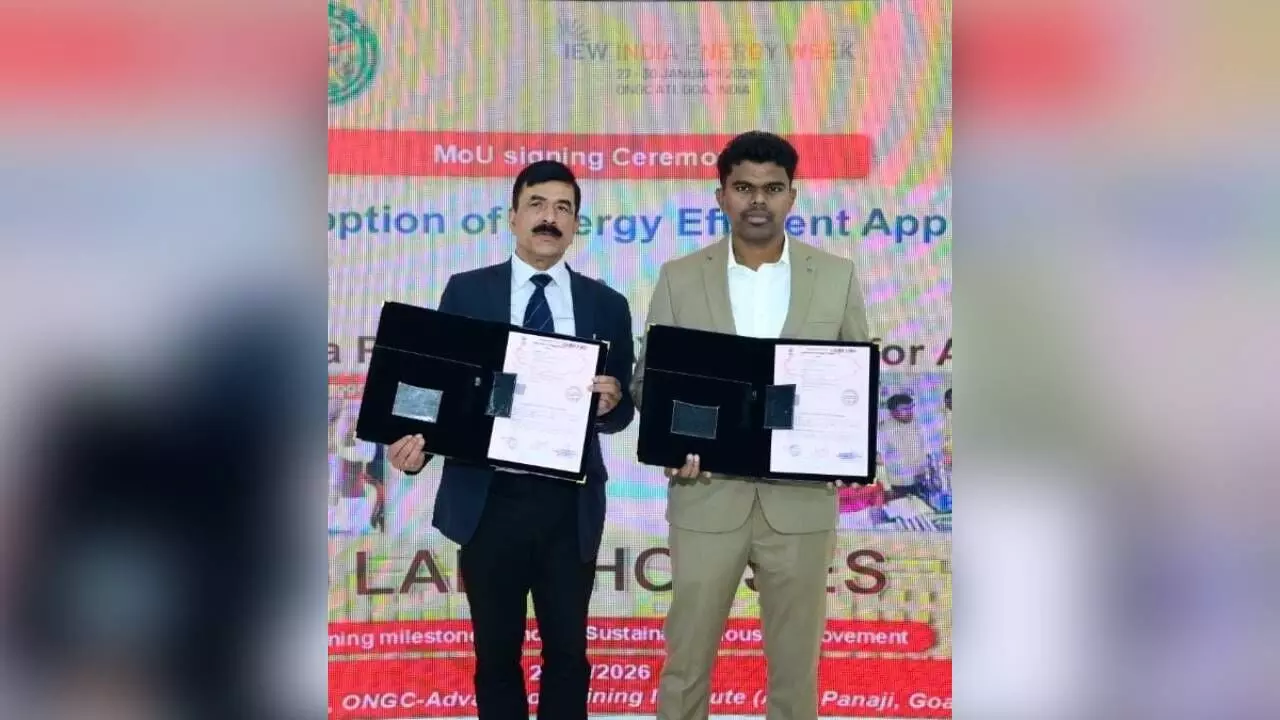
Managing Director of APSHDC P Arun Kumar exchanging MoU copies with Akhilesh Kumar Dixit, CEO of EESL at the India Energy Week celebrations in Goa on Thursday
Vijayawada: As part of efforts to achieve climate resilience, Andhra Pradesh Government has unveiled one of India’s most ambitious and large-scale energy efficiency initiatives in public housing, integrating high-efficiency appliances into Pradhan Mantri Awas Yojana (PMAY) home’s for lakhs of beneficiaries.
The initiative was formalised through a tripartite MoU between the Andhra Pradesh State Housing Corporation Limited (APSHCL), Energy Efficiency Services Limited (EESL)—a joint venture of Central PSUs under the Ministry of Power—and the Andhra Pradesh State Energy Efficiency Development Corporation (AP SEEDCO).
The MoU was signed at the India Energy Week (IEW) 2026 International Conference at ONGC ATI in Goa, in the presence of senior Government of India officials and global energy and sustainability experts on Thursday. The agreement was exchanged between Arun Babu, MD, APSHCL, and Akhilesh Kumar Dixit, CEO, EESL, marking a defining moment in India’s sustainable housing journey.
In the first phase, AP will equip 5 lakh PMAY households with energy-efficient appliances, making it the largest such public housing intervention in the country.
Each beneficiary family will receive: 4 LED bulbs, 2 LED batten lights & 2 BLDC (Brushless Direct Current) ceiling fans. This voluntary, large-scale transition aims to ensure families move into homes that are not just affordable—but energy-smart from day one.
Global energy experts at IEW 2026 highlighted the programme as a major milestone in India’s sustainable housing ecosystem.
With BLDC fans delivering up to 70–80 per cent energy savings and LED lighting significantly reducing power consumption, each household is expected to save approximately Rs3341.04 annually, translating into lower monthly electricity bills, improved indoor comfort, greater household energy security & long-term reduction in Statewide power demand.
Beyond households, the initiative delivers strategic benefits to the State’s power sector, including reduced peak electricity demand, lower stress on distribution networks, improved grid stability during high-summer months & optimised long-term energy planning.





